Baxi Boiler Parts Explained: What the Main Components Do
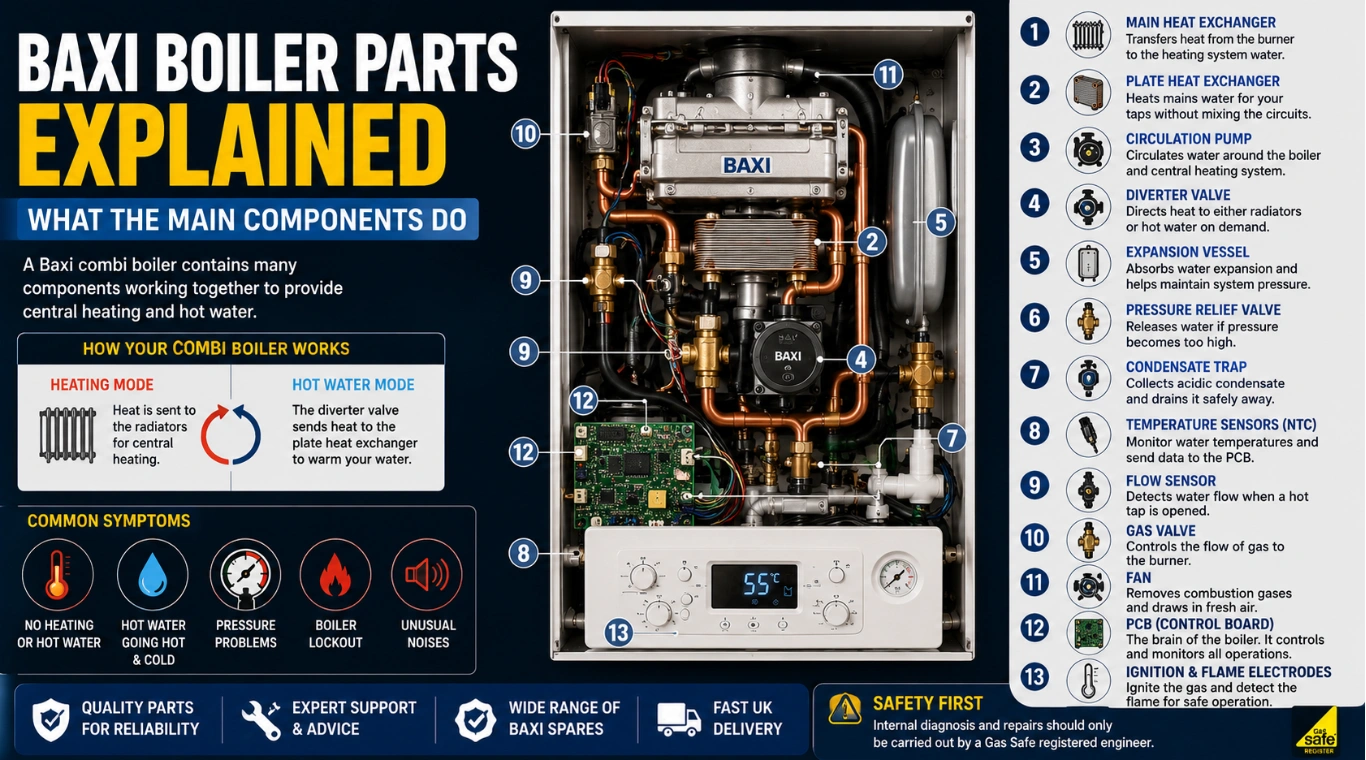
A Baxi combi boiler contains a number of components working together to provide central heating and hot water. Parts such as the heat exchanger, pump, diverter valve, expansion vessel, sensors, gas valve and PCB all have different roles, and a problem with one component can produce very different symptoms.
This guide explains the main parts found inside many Baxi combi boilers, what each component does and what symptoms may appear when something goes wrong. Component design and location vary between Baxi models, so always use the exact boiler model and manufacturer documentation when identifying replacement parts.
Safety note: Removing a boiler casing or working on internal gas, combustion or electrical components is not a homeowner task. Internal diagnosis and repair should be carried out by a Gas Safe registered engineer where required.
Table of contents
- Quick Answer: What Are the Main Parts Inside a Baxi Boiler?
- How the Main Baxi Boiler Parts Work Together
- Common Symptoms and Parts an Engineer May Investigate
- Can Homeowners Replace Baxi Boiler Parts?
- Why the Exact Baxi Model Matters When Ordering Parts
- Need a Replacement Baxi Boiler Part?
- Frequently Asked Questions
Quick Answer: What Are the Main Parts Inside a Baxi Boiler?
Depending on the Baxi model, the main components can include:
- Main heat exchanger
- Plate heat exchanger
- Circulation pump
- Diverter valve
- Expansion vessel
- Pressure relief valve
- Condensate trap
- Flow sensor
- NTC temperature sensors
- Fan
- Gas valve
- Ignition and flame-sensing electrodes
- Printed circuit board (PCB)
Each component performs a specific job. For example, the pump circulates heating water, the diverter valve directs heat between heating and hot water on a combi boiler, while the PCB coordinates the boiler’s operation.
Baxi itself describes a combi boiler as combining the heating and hot-water functions within one compact appliance. When a hot tap is opened, an internal valve directs heat towards domestic hot water instead of the radiator circuit.
1. Main Heat Exchanger
The main heat exchanger is one of the most important parts of a Baxi boiler.
Its job is to transfer heat produced by combustion into the water circulating through the boiler and heating system. The source places the main heat exchanger towards the top of the boiler and describes it as the component where heat from the burner is transferred to the central-heating water.
Modern Baxi 600 and 800 Combi 2 boilers, for example, use a stainless-steel heat exchanger.
What can happen when a main heat exchanger develops a problem?
Depending on the fault, symptoms can include:
- Boiler overheating
- Unusual kettling or boiling noises
- Poor circulation
- Water leaks
- Repeated lockouts
- Reduced heating performance
Sludge or restricted circulation elsewhere in the system can sometimes produce symptoms that appear to point towards the heat exchanger, so diagnosis is important before replacement.
2. Plate Heat Exchanger
On many Baxi combi boilers, the plate heat exchanger, sometimes called a secondary heat exchanger, is responsible for producing domestic hot water.
It transfers heat from the boiler’s primary heating circuit into the cold mains water supplying your taps. The two water circuits remain separate while heat passes through the metal plates.
Common symptoms associated with plate heat exchanger problems
Possible symptoms can include:
- Hot water going hot and cold
- Poor hot water temperature
- Reduced hot water flow
- Boiler heating radiators correctly but struggling with hot water
Scale or debris can restrict heat transfer, particularly in hard-water areas.
However, similar symptoms can also come from sensors, flow detection or the diverter valve, so a plate heat exchanger should not automatically be replaced based on symptoms alone.
3. Circulation Pump
The boiler pump circulates heated water through the boiler and central-heating system.
The source describes a Grundfos UPM-type pump in the training boiler, although the exact pump fitted varies by Baxi model.Without sufficient circulation, heat cannot move efficiently away from the heat exchanger and around the radiators.
Possible signs of a pump problem
These may include:
- Boiler overheating
- Radiators failing to heat properly
- Poor circulation
- Unusual humming or mechanical noise
- Boiler starting and stopping frequently
- Circulation-related fault codes
A circulation problem does not always mean the pump itself has failed. Air, sludge, closed valves or restrictions elsewhere in the system can produce similar symptoms.
4. Diverter Valve
The diverter valve is particularly important in a combi boiler.
When there is a demand for central heating, heated primary water is sent around the radiator circuit. When you open a hot tap, the boiler detects the demand and the diverter valve changes position so heat can be transferred through the plate heat exchanger to produce domestic hot water.
Baxi describes the same basic operating principle in its explanation of how a combi boiler works.
Symptoms that may be related to a diverter valve
A faulty or sticking diverter valve may contribute to:
- No hot water but heating works
- Heating working when hot water is requested
- Radiators becoming warm when using a hot tap
- Hot water temperature fluctuating
- Poor heating performance
Diverter-valve faults can be mechanical, motor-related or caused by another problem in the hydraulic system.
5. Flow Sensor or Hall Sensor
A combi boiler needs to know when somebody has opened a hot tap.
A flow sensor, often using a Hall-effect sensor depending on the model, detects water movement and sends a signal to the boiler controls.
The source explains that this hot-water flow signal is part of the sequence that tells the boiler to change over to domestic hot-water operation.
If the boiler fails to recognise a hot-water demand, the burner may not respond even though the heating side of the boiler operates normally.
Possible symptoms include:
- No hot water response when a tap is opened
- Boiler does not recognise hot-water demand
- Intermittent hot water
Again, the precise flow-sensing arrangement differs across Baxi boiler ranges.
6. Expansion Vessel
When heating-system water gets hotter, it expands.
The expansion vessel provides space for this increased volume and helps keep system pressure within an acceptable operating range.
The uploaded source describes it as a vessel commonly positioned towards the rear or side of the boiler. Current Baxi 600 and 800 Combi 2 specifications list a 7-litre integral expansion vessel, although capacity varies between models.
Possible symptoms of an expansion vessel problem
These can include:
- Pressure rising significantly when the heating comes on
- Pressure dropping after the system cools
- Water discharging from the pressure relief pipe
- Boiler repeatedly needing repressurisation
A vessel that has lost its charge may sometimes be serviceable, while a damaged diaphragm can require replacement. Diagnosis should come before replacing either the expansion vessel or PRV.
7. Pressure Relief Valve
The pressure relief valve, usually shortened to PRV, is an important safety component.
If sealed-system pressure becomes excessive, the PRV opens to allow water to escape and protect the heating system.
The source describes the PRV as a safety valve that releases water if pressure rises beyond the permitted level. Baxi’s latest 600 and 800 Combi 2 boilers also feature an integrated PRV arrangement designed to assist servicing and drain-down.
Signs that the PRV may be involved
You might notice:
- Water dripping from the external pressure relief pipe
- Boiler pressure dropping
- Pressure having previously risen too high
But the PRV may only be responding to another problem, such as an expansion vessel fault.
That is why simply replacing the PRV may not solve repeated pressure loss.
8. NTC Temperature Sensors
NTC thermistors are temperature sensors used by the boiler to monitor water temperatures.
NTC stands for Negative Temperature Coefficient. As the sensor temperature increases, its electrical resistance changes.
The boiler PCB uses this information to control burner output and keep water temperatures within the required range. The training source identifies sensors monitoring flow and return temperatures and stresses that engineers should compare sensor readings with the manufacturer’s technical information rather than guessing expected values.
Possible symptoms associated with an NTC sensor fault
Depending on the model and which sensor is affected:
- Incorrect temperature readings
- Hot water temperature problems
- Boiler overheating or shutting down
- Boiler cycling unexpectedly
- Sensor-related fault codes
- Sometimes poor operation without an obvious fault code
Electrical resistance testing and expected values should always be checked against the technical documentation for the exact boiler.
9. Condensate Trap
Modern condensing boilers produce water as part of the process of recovering additional heat from the combustion gases.
The condensate trap collects this condensate and allows it to leave the boiler through the condensate drainage system.
Baxi’s current 600 Combi 2 also features a pre-heated condensate trap intended to reduce the risk of freezing in cold weather.
What happens if the condensate system has a problem?
Possible symptoms can include:
- Boiler lockout
- Gurgling noises
- Condensate backing up
- Ignition problems
- Water appearing where it should not
A blocked condensate system can potentially cause more serious problems if water backs up into the boiler, so it should not simply be repeatedly reset without investigating the cause.
10. Gas Valve
The gas valve controls the gas supplied to the burner.
It does not simply operate as an on/off tap. Modern boilers can modulate their burner output, with the boiler controls adjusting operation according to heating demand.
The uploaded source describes the gas valve as being controlled by the PCB according to the boiler’s requirements.
Possible symptoms associated with gas-valve problems
These can include:
- Boiler failing to ignite
- Intermittent ignition
- Flame-related fault codes
- Boiler attempting to start but failing to establish a flame
However, ignition faults can also come from gas supply issues, electrodes, wiring, the PCB and other components.
Gas valve testing and replacement are Gas Safe engineer work.
11. Fan
The fan is part of the boiler’s combustion and flue system.
It helps move the required air through the appliance and ensures combustion products are safely expelled through the flue.
The boiler control system must confirm correct operation before allowing the combustion sequence to continue.
Possible fan-related symptoms can include:
- Boiler failing to ignite
- Fan-related fault codes
- Unusual fan noise
- Intermittent lockouts
The fan forms part of the room-sealed combustion system, so homeowner dismantling or testing is not appropriate.
12. Ignition and Flame-Sensing Electrodes
The boiler needs both to light the burner and confirm that a stable flame has been established.
Depending on the model, electrodes may provide:
- Ignition spark
- Flame detection
- Or a combined ignition and detection function
Problems with the electrodes, their wiring or associated components can contribute to ignition or flame-loss fault codes.
Baxi’s current maintenance Care Kits also include electrodes and relevant gaskets in certain kits, showing their role as serviceable boiler components.
These parts sit within the combustion area and should be inspected and replaced by competent engineers.
13. Printed Circuit Board (PCB)
The PCB is essentially the boiler’s main control board.
It receives information from sensors and controls components such as:
- Pump
- Fan
- Gas valve
- Ignition system
- Diverter-valve actuator
- Temperature controls
When you request heating or hot water, the PCB coordinates the sequence required to operate the boiler safely.
Possible PCB-related symptoms
Because the PCB controls so many functions, symptoms can vary considerably:
- Boiler completely dead
- Intermittent operation
- Components not receiving the correct signal
- Random or repeated fault codes
- Display problems
- Ignition sequence failing
A fault code associated with a component does not necessarily prove the PCB is faulty, and a PCB should not be replaced without proper diagnosis.
How the Main Baxi Boiler Parts Work Together
A simple way to understand a Baxi combi boiler is to look at the sequence.
For central heating:
Thermostat calls for heat → PCB responds → pump circulates water → fan and combustion sequence operate → burner heats main heat exchanger → heated water goes to radiators
For hot water:
Hot tap opens → flow sensor detects demand → PCB responds → diverter valve changes position → boiler fires → heat passes through the plate heat exchanger → hot water reaches the tap
If one component in the sequence does not operate correctly, the boiler may stop, display a fault code or continue operating with reduced performance.
Common Symptoms and Parts an Engineer May Investigate
| Boiler symptom | Components that may be investigated |
| No hot water but heating works | Flow sensor, diverter valve, plate heat exchanger, DHW sensor |
| Radiators heat when hot tap is running | Diverter valve |
| Boiler overheating | Pump, circulation, heat exchanger, NTC sensors |
| Pressure rises and then falls | Expansion vessel, PRV, system pressure |
| Water from relief pipe | PRV, expansion vessel, system pressure |
| Boiler will not ignite | Electrodes, fan, gas valve, PCB, gas supply |
| Hot water goes hot and cold | Plate heat exchanger, sensors, flow detection, circulation |
| Boiler completely dead | Electrical supply, controls, PCB |
| Repeated temperature faults | NTC sensors, circulation, pump, heat exchanger |
This table should be treated as a diagnostic starting point, not a parts-replacement list.
Can Homeowners Replace Baxi Boiler Parts?
For most internal Baxi boiler components, no.
A homeowner can safely perform basic checks such as:
- Reading the boiler pressure gauge
- Checking the display for a fault code
- Confirming that power is available
- Checking the thermostat or programmer
- Following permitted reset instructions in the user manual
Internal work involving the boiler casing, combustion chamber, gas valve, fan, electrodes, PCB or internal electrical components should be left to an appropriately qualified engineer.
The original source is especially clear that burner-door sealing, disturbed gas connections and combustion checks require professional procedures and equipment.
Why the Exact Baxi Model Matters When Ordering Parts
This is especially important for HCP customers.
A part described simply as a “Baxi pump”, “Baxi gas valve” or “Baxi PCB” is not automatically compatible with every Baxi boiler.
Baxi has produced many ranges and revisions, including current and older models. Component design, manufacturer part numbers and compatibility can change.
- Full Baxi boiler model
- GC number where available
- Manufacturer part number
- Number on the existing component
- Appliance serial or production information where required
Baxi also recommends identifying the correct approved spare part for the appliance rather than relying on whether a component simply appears to fit.
Need a Replacement Baxi Boiler Part?
Heating & Catering Parts stocks a wide range of Baxi boiler spares, including pumps, heat exchangers, expansion vessels, diverter valves, sensors, fans, gas valves, PCBs and other replacement components.
Always confirm compatibility before ordering.
If you are unsure which Baxi part you need, send us:
- A clear photo of the boiler data plate
- Boiler model
- GC number if available
- Existing part number
- A clear photo of the component
This gives us the best information to help identify the correct replacement.
Frequently Asked Questions
Typical components include the main heat exchanger, plate heat exchanger, pump, diverter valve, expansion vessel, PRV, sensors, condensate trap, fan, gas valve, electrodes and PCB. The exact components vary by model.
On a combi boiler, it directs primary heating water either towards the central-heating circuit or through the plate heat exchanger when domestic hot water is required.
It absorbs the additional volume created as heating-system water expands, helping to keep boiler pressure stable.
The pump circulates heated water through the boiler and central-heating system. Poor circulation can contribute to overheating and heating-performance problems.
On a combi boiler, it transfers heat from the primary boiler water to the mains water used at hot taps.
Key Takeaways
- Baxi boiler parts work together to provide central heating and hot water, with each component serving a specific function.
- Common components include the main heat exchanger, diverter valve, pump, and PCB among others, each having unique symptoms when malfunctioning.
- Many symptoms can overlap between components, so proper diagnosis is essential before replacement.
- Homeowners should leave internal repairs to qualified engineers but can perform basic checks like monitoring pressure and fault codes.
- When ordering replacement parts, always refer to the exact Baxi model to ensure compatibility.